
Your Shopify Store Deserves to Rank on Page One — Not Page Ten
Most SEO agencies don’t understand Shopify. We do. We fix the exact issues — duplicate URLs, bloated apps, broken pagination — that hold Shopify stores back from dominating search.
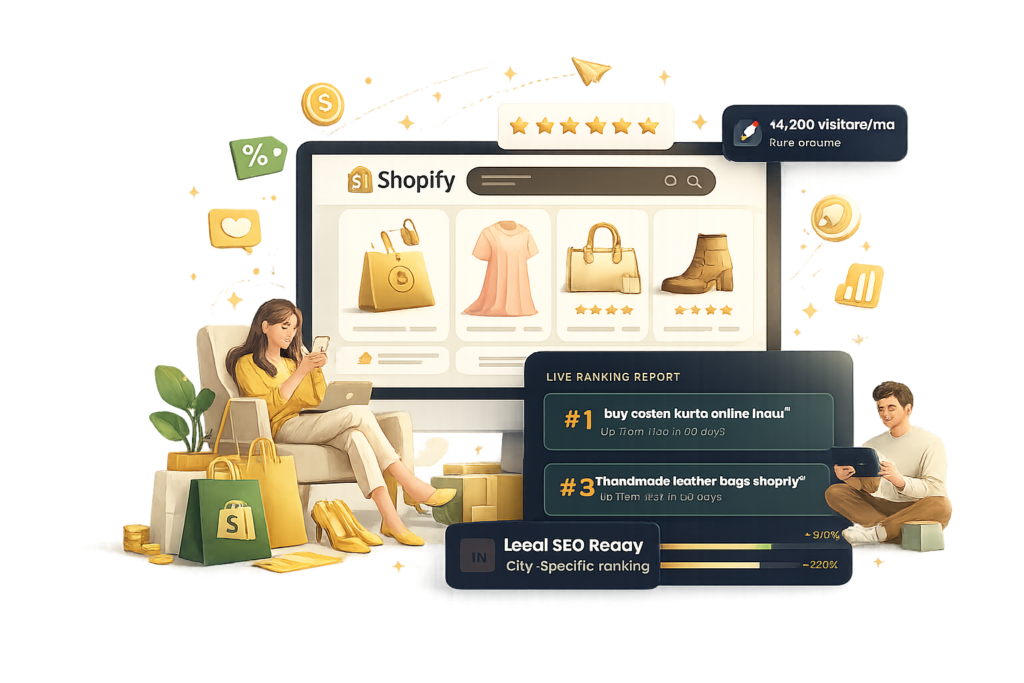
Product Page Optimisation
Collection Page SEO
Duplicate Content Fixes
Shopify Schema Markup
Shopify SEO
Product Page Optimisation
Collection Page SEO
Duplicate Content Fixes
Shopify Schema Markup
Shopify SEO
—–The Problem
Shopify has SEO challenges most agencies don't even know about
Shopify is an incredible platform for selling — but it creates specific technical SEO issues that generic agencies consistently miss. These problems silently tank your rankings while you wonder why your store isn’t growing.
We’ve audited over 340 Shopify stores. These are the issues we find in 90% of them:
Pagination handled incorrectly
Shopify's default pagination doesn't use rel="next/prev" properly, and collection pages beyond page 2 rarely get indexed — meaning most of your products are invisible to Google.
Duplicate product URLs
Shopify creates two URLs for every product — one under /products/ and one under /collections/. Google sees duplicate content and dilutes your ranking power across both.
App bloat slowing your store
Each Shopify app adds JavaScript and CSS. Most stores have 15–30 apps. This directly hurts Core Web Vitals and Google's page experience score — both ranking factors.
Faceted navigation creating crawl waste
Filter URLs (colour, size, price) create thousands of indexable pages with near-identical content. Google wastes crawl budget on these instead of your money pages.
—– Technical Deep Dive
How we fix Shopify's biggest SEO problems
- Duplicate URLS
- Speed & Core Web Vitals
- Schema & Rich Results
- Crawl Budget
The Shopify duplicate URL problem — solved
Shopify automatically creates two URLs for every product. When it appears in a collection, it gets a secondary URL like /collections/shoes/products/nike-air-max alongside the canonical /products/nike-air-max.
This splits your link equity and ranking signals between two pages. We implement a canonical tag strategy that consolidates authority to the right URL — then clean up any existing Google Search Console errors this has caused.
- Audit every product URL in your store for duplication.
- Implement canonical tags pointing to primary product URLs.
- Fix internal links to use canonical URLs throughout the theme.
- Submit updated sitemap to Google Search Console.
- Monitor re-indexation progress over 30 days
Shopify speed — from 34 to 91 in 6 weeks
Shopify stores accumulate app bloat fast. Every installed app injects code — even apps you’ve disabled. The average Shopify store loads 4.2MB of JavaScript before showing a single product image.
We perform a full app and theme performance audit, removing dead code, deferring non-critical scripts, and optimising every image in your catalogue — turning a slow store into a fast one that Google rewards.
App performance audit — identify which apps are killing speed
Remove orphaned app code from uninstalled apps
Defer non-critical JavaScript to improve LCP
Convert all product images to WebP format
Implement lazy loading for below-fold content
Schema markup — own the search results page
Rich results — star ratings, price, availability, breadcrumbs — make your listings stand out and significantly increase click-through rates. Shopify’s default schema is basic and often incorrect.
We implement comprehensive structured data for every product type, enabling rich snippets that make your results look dramatically better than competitors who are skipping this step.
Product schema with price, availability, ratings, and reviews
Breadcrumb schema for every product and collection page
FAQ schema on buying guides and product description pages
Organisation and sitelinks schema for brand searches
Google Merchant Center feed alignment
Crawl budget — stop Google wasting time on the wrong pages
Google allocates a crawl budget to your site — a limit on how many pages it crawls per day. Shopify stores waste enormous amounts of this on filter URLs, search result pages, and duplicate collection paths.
When crawl budget is wasted, your real product and collection pages get crawled less frequently — meaning ranking improvements take longer, and new products take weeks to appear in search.
Identify and noindex filter/facet URLs generating crawl waste
Block crawl of internal search result pages via robots.txt
Consolidate pagination via canonical or noindex
Submit clean XML sitemap with priority pages only
Monitor crawl stats in Search Console weekly
—– Technical Deep Dive
How we fix Shopify's biggest SEO problems
The Shopify duplicate URL problem — solved
Shopify automatically creates two URLs for every product. When it appears in a collection, it gets a secondary URL like /collections/shoes/products/nike-air-max alongside the canonical /products/nike-air-max.
This splits your link equity and ranking signals between two pages. We implement a canonical tag strategy that consolidates authority to the right URL — then clean up any existing Google Search Console errors this has caused.
- Audit every product URL in your store for duplication
- Implement canonical tags pointing to primary product URLs
- Fix internal links to use canonical URLs throughout the theme
- Submit updated sitemap to Google Search Console
- Monitor re-indexation progress over 30 days
← PageRank: 4.2 · Links: 12
/collections/shoes/products/nike-air-max
← PageRank: 3.8 · Links: 8
← Duplicate content warning ⚠️
← PageRank: 8.0 · Links: 20
← rel="canonical" set ✓
/collections/shoes/products/nike-air-max
← canonical → /products/nike-air-max
← Not indexed ✓
Shopify speed — from 34 to 91 in 6 weeks
Shopify stores accumulate app bloat fast. Every installed app injects code — even apps you've disabled. The average Shopify store loads 4.2MB of JavaScript before showing a single product image.
We perform a full app and theme performance audit, removing dead code, deferring non-critical scripts, and optimising every image — turning a slow store into a fast one that Google rewards.
- App performance audit — identify which apps are killing speed
- Remove orphaned code from uninstalled apps
- Defer non-critical JavaScript to improve LCP
- Convert all product images to WebP format
- Implement lazy loading for below-fold content
Schema markup — own the search results page
Rich results — star ratings, price, availability, breadcrumbs — make your listings stand out and significantly increase click-through rates. Shopify's default schema is basic and often incorrect.
We implement comprehensive structured data for every product type, enabling rich snippets that make your results look dramatically better than competitors skipping this step.
- Product schema with price, availability, ratings and reviews
- Breadcrumb schema for every product and collection page
- FAQ schema on buying guides and product pages
- Organisation and sitelinks schema for brand searches
- Google Merchant Center feed alignment
Crawl budget — stop Google wasting time on the wrong pages
Google allocates a crawl budget to your site — a limit on how many pages it crawls per day. Shopify stores waste enormous amounts of this on filter URLs, search result pages, and duplicate collection paths.
When crawl budget is wasted, your real product and collection pages get crawled less frequently — meaning ranking improvements take longer and new products take weeks to appear in search.
- Identify and noindex filter/facet URLs generating crawl waste
- Block crawl of internal search result pages via robots.txt
- Consolidate pagination via canonical or noindex
- Submit clean XML sitemap with priority pages only
- Monitor crawl stats in Search Console weekly
—–How It Works
What Shopify stores achieve with our SEO
Google rolled out AI Overviews (formerly SGE) to billions of searches in 2024. These AI-generated summaries appear above all organic results and capture up to 27% of clicks before anyone scrolls.
Ranking #1 no longer guarantees traffic. You need to appear in the AI Overview and rank organically. We optimise your content specifically for both.
The formula for AI Overview inclusion involves three things: structured content that directly answers questions, strong E-E-A-T signals (Experience, Expertise, Authoritativeness, Trustworthiness), and schema markup that helps Google’s AI extract your content accurately.
—–Our Process
From audit to ranking — our Shopify SEO process
Shopify Store Audit
We crawl every page of your store — products, collections, blog posts, and all generated URLs. We map duplicate content, measure Core Web Vitals, audit your backlink profile, and benchmark you against your top 5 competitors. You receive a prioritised fix report within 48 hours.
Keyword & Competitor Research
AI-powered keyword research maps every product and collection to the exact search terms your buyers use — from broad category terms to specific product model searches. We identify the gaps your competitors have left open and build your 90-day content and optimisation roadmap around them.
Technical Fixes & On-page Optimisation
We implement all technical fixes — canonical tags, schema markup, speed improvements, robots.txt, sitemap — and optimise every product title, meta description, and collection page. All changes are tracked in your live dashboard.
Content & Link Building
We publish buying guides, comparison content, and category articles that capture commercial intent traffic. Simultaneously, our AI-powered outreach builds high-quality links from relevant ecommerce and industry publications — increasing your store's domain authority month on month.
Reporting & Scaling
Monthly AI-generated reports show exactly which rankings moved, what revenue was driven by organic search, and what we're doing next. We iterate on what's working and adapt rapidly to Google updates — compounding your results every month.
—- Interactive Tool
Is your Shopify store suffering from these issues?
What are you experiencing with your Shopify store?
Select all that apply
—–What We Do
Shopify SEO services built for ecommerce growth
Shopify Technical SEO
We fix the platform-specific issues that generic agencies miss — duplicate product URLs, canonical tag errors, JS render blocking, and crawl budget waste from filter pages.
- Duplicate URL resolution (canonical strategy)
- Faceted navigation & filter URL management
- Shopify sitemap optimisation
- Crawl budget analysis and clean-up
Product Page Optimisation
Turn product pages into high-ranking, high-converting landing pages. AI-optimised titles, descriptions, schema markup, and internal linking — all built to attract buyers, not just browsers.
- Product title and meta optimisation
- Product schema & rich snippet setup
- Buyer-intent keyword targeting
-
Product image alt text optimisation
Collection Page SEO
Collection pages are the highest-value SEO opportunity in Shopify — yet most stores leave them completely unoptimised. We turn them into powerful category landing pages that capture high-intent shoppers.
- Collection page content strategy
- Category keyword targeting
- Internal linking from collection to products
- Pagination SEO fix
Shopify Speed Optimisation
Every 1-second delay costs 7% in conversions. We audit your app stack, remove render-blocking resources, optimise images, and implement lazy loading — turning a slow store into a fast one.
Ecommerce Content Strategy
Buying guides, comparison content, and "best X" articles drive high-intent traffic that converts. Our AI maps the full search landscape around your products and builds a content strategy that captures buyers at every stage.
Local & International Shopify SEO
Selling in multiple regions? We implement hreflang tags, geo-targeted content, and multi-currency SEO strategies so your store ranks in every market you sell to — without cannibalising your existing rankings.
—–Client Results
Shopify store owners who made the switch

Laura Thompson
Founder, StyleHouse London
Raj Kumar
CEO, Glow Naturals
Mark Wilson
Owner, TrailReady
—–FAQ
Shopify SEO questions, answered honestly
No jargon. No vague answers. Just clear explanations of how AI SEO works.
Yes — several. The most significant are the duplicate product URL issue (where every product gets two URLs), the way Shopify handles faceted navigation (filters creating thousands of crawlable but low-value URLs), and app bloat slowing Core Web Vitals. These are Shopify-specific problems that generic SEO agencies frequently miss because they’re not familiar with the platform’s architecture. Every one of them is fixable, and fixing them typically produces rapid ranking improvements.
Technical fixes like duplicate URL resolution and speed improvements show results fastest — typically within 4–6 weeks as Google re-crawls and re-evaluates your pages. Collection and product page ranking improvements usually appear within 6–10 weeks. Content-driven keyword growth (buying guides, category pages) builds from month 2 onwards and compounds significantly by month 4–6. We give every client a realistic projection based on their store’s current state, competition level, and domain authority at the start of the project.
Yes, but the strategy is different. New stores start with long-tail, low-competition keywords that established competitors are ignoring. We build domain authority through content and link building while simultaneously optimising your technical foundation. Most new stores see their first page-one rankings within 60–90 days for carefully selected target keywords. Results compound faster once you reach a DA of 20+, which typically takes 3–4 months of consistent effort.
Absolutely — this is one of our most common starting points. We’ve successfully recovered 40+ Shopify stores from Google algorithm penalties and updates, including the Helpful Content Update, Product Reviews Update, and various Core Updates. Recovery always starts with identifying the specific signals Google downgraded — which could be thin content, E-E-A-T issues, technical problems, or link quality — then systematically addressing them. Most recoveries take 8–16 weeks depending on the severity.
Not necessarily. Most SEO improvements can be made within your existing theme through Shopify’s theme editor, metafields, and custom Liquid code edits. We only recommend a theme change if the current theme has fundamental performance issues that can’t be resolved through optimisation — for example, a very old theme that doesn’t support lazy loading or generates excessive render-blocking scripts. If a theme change is warranted, we’ll recommend Shopify’s Dawn or a well-built paid theme and handle the migration for you.
Our Shopify SEO retainers start from £800/month for smaller stores (under 200 products) and scale based on catalogue size, market competition, and the scope of work required. Every engagement begins with a free audit so we can give you an accurate quote based on what your specific store needs — not a generic package. We operate month-to-month with no lock-in contracts, because we believe results should justify the continued investment, not a contract obligation.
—–Free Shopify Store Audit
Find out exactly what's holding your store back
Enter your store URL and email — we’ll send you a detailed audit identifying every SEO issue holding your Shopify store back from page one. Free, no commitment.